On this page
The short version
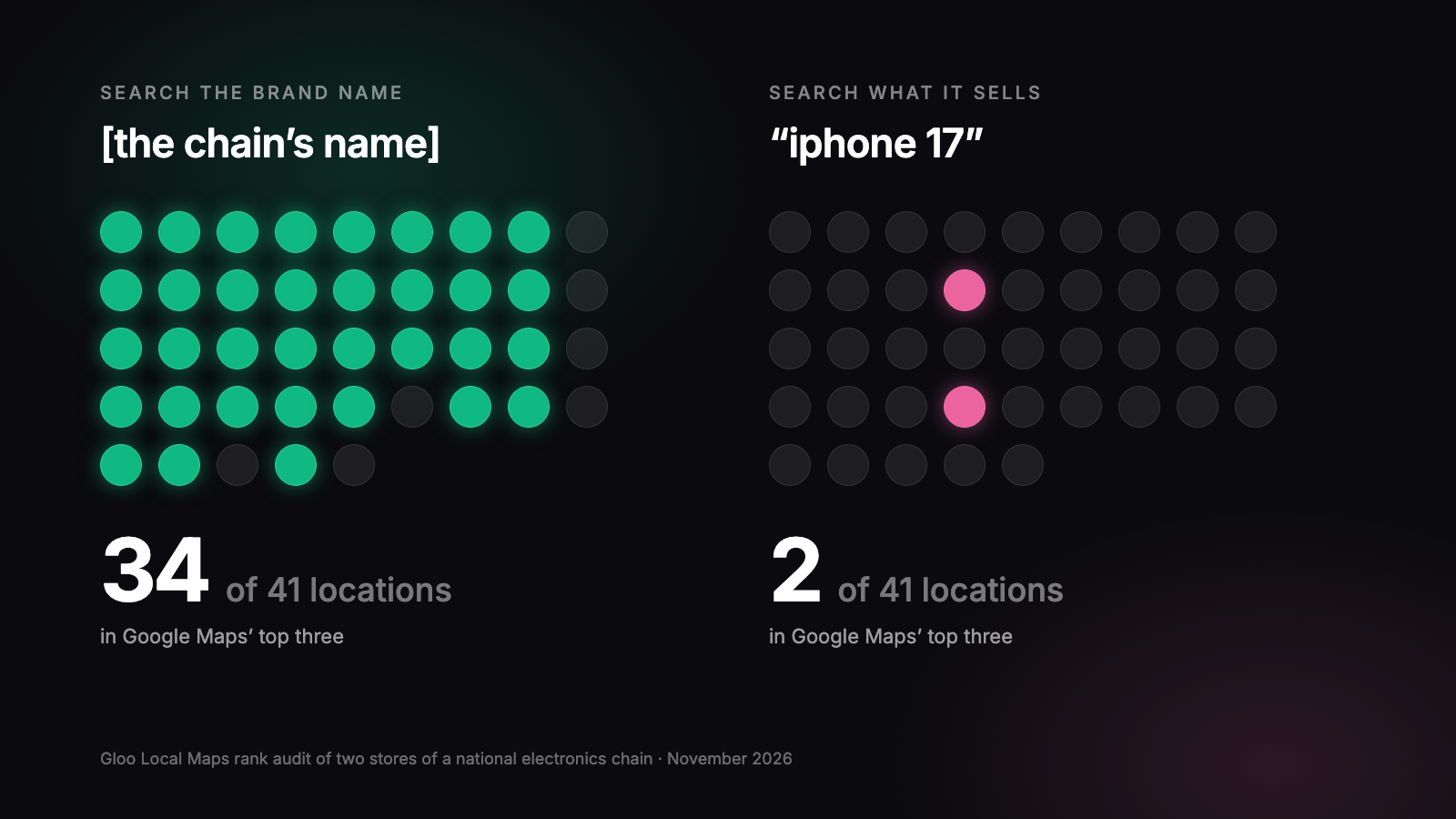
- Searching a chain's own name put its stores in Google's top three at 34 of 41 locations we tested.
- Searching for what it sells (iPhone 17, TV shop, laptop store, mobile shop) did it at 2 of 41 or fewer.
- The product searches are the bigger market: iPhone 17 alone was searched about 7× as often as the chain's name plus “near me”.
- The fixes aren't marketing. They're store operations: replies, listings, and one owner per store.
Every multi-location brand I speak to tells me some version of the same thing: “We're fine on Google. Search for us and we come up first.”
They're right. And it's the wrong test.
Earlier this month we ran a Google Maps audit for two stores of a national electronics chain, one in Bengaluru and one in Mumbai. It's a household name. You'd assume its stores are impossible to miss. What we found is the clearest example I've seen of a problem almost every chain has, and almost nobody measures.
The brand search is a vanity metric
We tested Google Maps rankings from 41 points around the two stores, within roughly a kilometre and a half of each. At every point we searched the way real shoppers do, and recorded whether the chain's store appeared in the top three results, the ones Google shows before anyone scrolls.
When we searched for the chain's own name, it was a near sweep: top three at 34 of 41 locations. That's the screenshot that goes into the monthly marketing report.
Then we searched for the things the stores actually sell.
How often the chain's store made Google Maps' top three
41 locations tested around two stores, November 2026
Source: Gloo Local Maps rank audit of two stores, 16–17 November 2026 (brand name 34 of 41 locations; iPhone 17, TV and laptop 2 of 41 each; mobile 0 of 41)
Top three at two locations out of 41. For mobile phones, in a store that sells mobile phones, zero.
Don't take my word for it. This is Google Maps, live, for the same search in the same city. Count how many of the businesses you'd call household names make the first three.
Google Maps right now: “iphone 17 store” in Bengaluru
Live from Google MapsThe people who search the brand name have already decided where to go. The people searching “iphone 17” or “tv shop near me” haven't, and that's the market you're actually competing for. In these two cities, “iphone 17” alone was searched roughly 614,000 times a month, about seven times as often as the chain's name with “near me”.
If your Google report only tracks searches for your own name, it is measuring the customers you already had.
Who won those searches? One national rival, yes. But just as often, independent stores and authorised resellers with a few hundred reviews, a near-perfect average and a profile that looked lived in. One reseller with 389 reviews made the top three at 14 of the 25 points around the Bengaluru store. The household name made it at one.
This isn't a marketing problem. It's a handoff problem.
When I show a chain these numbers, the first instinct is a marketing fix: more posts, more ads, a new agency. Those are rarely where the gap is. Look at what was actually broken.
At the Bengaluru store, 41 of the latest 100 Google reviews were one or two stars. Not one of the 100 had a public reply. Every complaint about a delayed delivery or a refused exchange was the last word on the store's own profile, sitting right above the directions button.
The Mumbai store did reply, to 39 of its 41 unhappy customers. But every reply sent the customer to an email address, and almost all of them were one of three templates. One customer had waited twenty days for an AC repair. The public answer was: please write to us.
A reply that only says “email us” isn't customer service. To the next shopper reading it, it's a closed door. BrightLocal's 2026 consumer survey found that 89% of people expect owners to respond to reviews, and half say generic, templated responses make them less likely to choose a business.
Then the listings. For the Mumbai store we found two live store pages on the chain's own website for the same store, and directories showing the wrong address, the wrong hours, a toll-free number instead of the store's, and an old website. None of these is a marketing decision. Each one is a fact that changed at the store, or at head office, and never made it across.
That's the pattern I see over and over in multi-location brands, whether it's 20 phone stores, 60 restaurants or 400 electronics showrooms. Head office owns the brand. Stores own the reality. Google sits in the gap between them, and nobody is assigned to that gap.
What I'd fix first, in order
If you run Google for a chain, here is the order I'd work in. It's not glamorous, and it doesn't need a bigger budget.
- 1
Measure category searches, store by store
Stop reporting only your brand name. Pick the five things people buy from you and scan them around each store. The gap between the brand line and the category line is your real opportunity.
- 2
Reply to every review, at the store, in public
Specific, human replies, negative ones first, within a working day. If a case needs email, say what you're already doing about it in the reply itself.
- 3
Give every fact one owner
Hours, phone numbers and holiday hours belong to the store manager. Brand name, categories and links belong to head office. Write it down, and make updating Google part of the same checklist as the sign on the door.
- 4
Clean up duplicates and directories
One store, one store page, one phone number everywhere. Duplicates split your signals and confuse shoppers.
- 5
Re-scan monthly
Run the same scan from the same points. If the category line isn't moving, the work isn't reaching Google.
Where software helps, and where it shouldn't
I build software for this, so take this with the bias it deserves. Doing the above by hand works for five stores. At fifty, it slips the week someone goes on leave.
In Gloo Local, AI agents do the watching and the drafting: they scan rankings, draft review replies and Google posts from each store's approved details, and flag listings that drift. People do the deciding. Head office sets the rules once. Each store gets a short weekly list of what needs them, and nothing customer-facing goes out without a person approving it.
What software shouldn't do is pretend the problem is solved because a dashboard is green. The only test that matters is the one we started with: search for what you sell, from where your customers stand, and see who Google shows first.
Try this on your own stores this week
- Pick 3 stores and the 3 products or categories you sell most
- Search each one on Google Maps from a few points around the store
- Count how often your store is in the top three, versus for your brand name
- Read the last 20 reviews at each store: how many have a real reply?
- Check each store has exactly one store page, one phone number and correct holiday hours
Questions we get asked
Why does my brand rank first but my stores don't show up for product searches?
A brand-name search tells Google exactly which business you want, so your profile wins easily. Category and product searches are open contests between every nearby store, and Google weighs relevance, distance and prominence: how complete the profile is, how active it looks, and what reviews and replies say. Many chains are strong on the first and weak on the second.
How do you measure local rankings for a multi-location brand?
Use a grid scan: search the same terms from many points around each store and record whether the store appears in Google Maps' top three. Repeat it from the same points every month so the trend is comparable.
Should store managers or head office reply to Google reviews?
Either can draft, but replies should be specific to the store and the complaint. A common setup is AI-drafted replies that a store or regional manager approves, with head office setting the tone and rules.
Written by
Akhil Singh
Gloo
Akhil builds Gloo, the software behind Gloo Local and the GlooTV App, and works with multi-location brands on how they show up on Google and on the screens inside their stores.
Published · Last updated