Restaurant Digital Menu Board Software
Use TVs for menu boards, meal-time changes, and special offers without relying on reprints or one-off store fixes. Keep restaurant screen content simple and current.
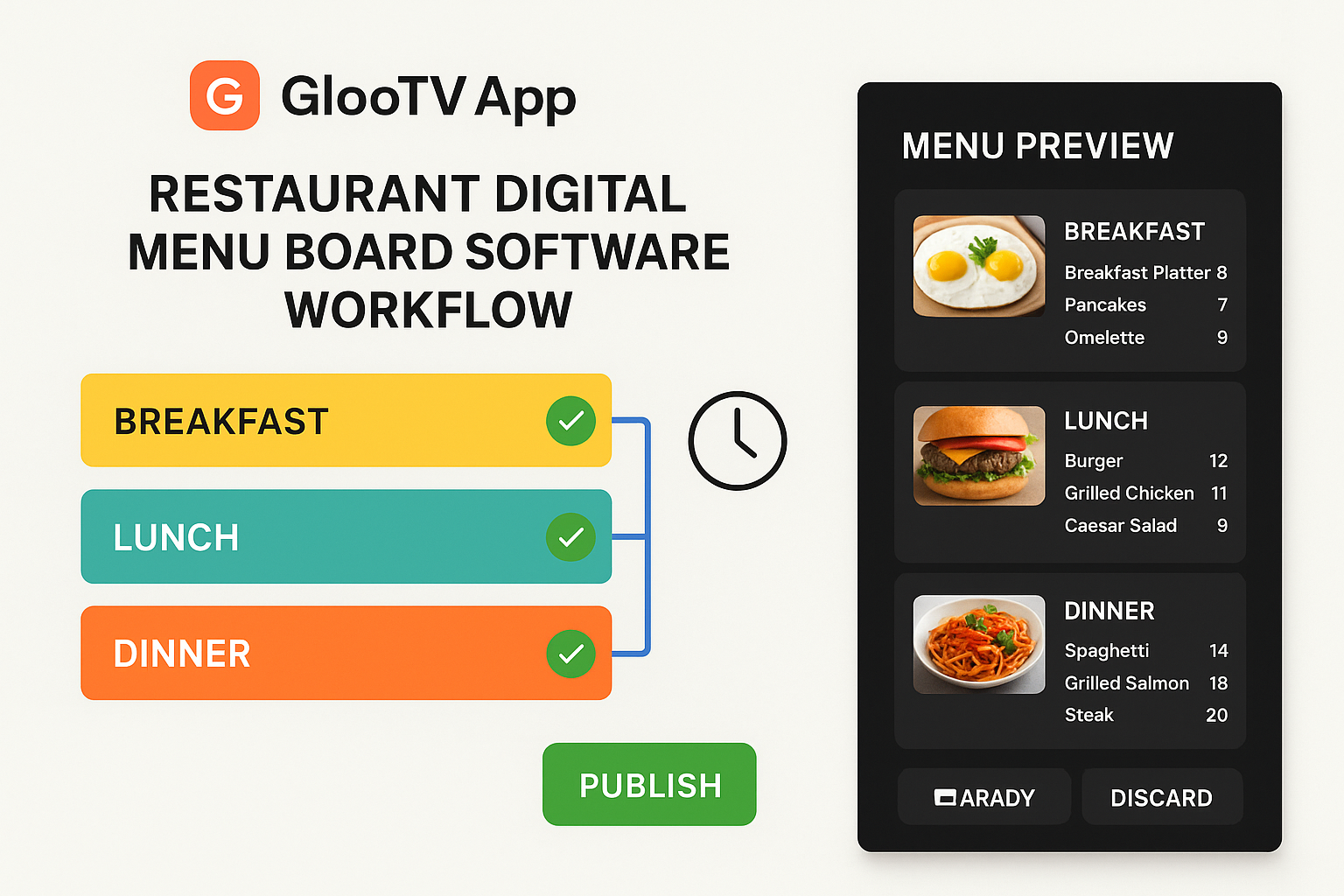
Keep restaurant menus, specials, and timed offers updated from one place.
Show menus and specials on TV
What this lets you do
This helps restaurants use TV screens for menu content, timed offers, and daily updates without rebuilding boards at each location.
Why teams use it
- Restaurants replacing static menu boards with TV screens
- Operators managing daily specials and price changes
- Teams that want simpler control over menu and promo content
How it works
Structure the menu
Define categories, pricing, and promotional zones for screen use.
Build readable layouts
Use formats that stay clear in queue, counter, and dining areas.
Schedule meal-time changes
Switch breakfast, lunch, dinner, or special campaigns at the right time.
Push updates remotely
Update one store or many stores without local rework.
What you can show on the screen
Main menu boards
Breakfast, lunch, and dinner variations
Daily specials and limited-time dishes
Combo banners and promotional inserts
How teams stay in control
- Remote updates for menu and price content
- Daypart and date-based scheduling
- Promo blocks inside menu loops
- Location and screen-group publishing
- Android TV support for restaurant screens
- Playback continuity between syncs
Integrations
- Google Sheets or CSV menu feeds
- POS and catalog sync via API or structured data feed
- Google Reviews and social content sync
- QR-based customer ordering links
Device compatibility matrix
| Android TV app | Native app for Android TV and Google TV devices |
| Screen orientation | Landscape and portrait layouts with safe zones |
| Multi-location control | Push updates by location, region, or all screens |
| Offline continuity | Last published playlist stays on-screen during outages |
Value in day-to-day use
Menu upkeep
Less manual board work
Restaurants can reduce repeated local screen changes
Special launch speed
Faster rollout
Specials and campaign updates can go live quickly
Location alignment
More consistent screens
Stores stay closer to approved menu timing and pricing
Context: wording reflects operational improvements common in restaurant screen deployments rather than a fixed benchmark.
Common store examples
Daily special rotation
Swap featured dishes by time of day without rebuilding the whole board.
Price update sweep
Push approved price changes to selected locations at once.
Promo plus menu screen
Keep core menu content visible while rotating high-margin upsell offers.
Manual work vs cloud control
| Manual or static workflow | Cloud signage workflow |
|---|---|
| Menu changes depend on prints or local edits | Updates can be published remotely |
| Meal-time switching is inconsistent | Schedules make transitions predictable |
| Specials are hard to launch across stores | Campaign content can be pushed in one workflow |
| Stores drift from the approved board | Shared control helps keep locations aligned |
Frequently asked questions
1. Can I show restaurant menus on TV?
Yes. GlooTV lets restaurants run menus, specials, and meal-time content on TV screens.
2. Can I automate breakfast and dinner screen changes?
Yes. Daypart scheduling can switch menu content based on the time of day.
3. Can I mix promotions with menu boards?
Yes. Promotional content can be added into the same screen loop.
4. Does this work on Android TV?
Yes. Android TV is supported for restaurant screen deployment.
5. Can multiple locations share the same setup?
Yes. Shared layouts and centralized publishing support multi-location teams.
6. What happens if a screen disconnects?
Previously synced content remains on screen until the next update succeeds.
Related pages
The broader menu-board software page
Quick-service menu workflows
Android TV setup details
The overall GlooTV solution page
Put this on your screens without extra store work
Start with cloud publishing, simple schedules, and Android TV support so your team can keep every screen current from one place.