QSR Digital Menu Board Software
Update QSR menu boards, combo promotions, and meal-time screens from one dashboard. Keep fast-moving menu content current without rebuilding boards at each store.
Create a free account to explore GlooTV. If you choose premium, the monthly plan covers up to 3 TVs: ₹2,099 in India or $29 in the US. Payment starts only after you authorize checkout.
QSR chains running frequent menu and combo changes
Operators who need breakfast, lunch, and dinner switching on time
Teams that want less local effort when campaigns change
See a demo, talk to sales, or create a free account.
Share a few details and we will follow up with the right next step — whether that is a tailored demo, a quick call, or getting started with your own account.
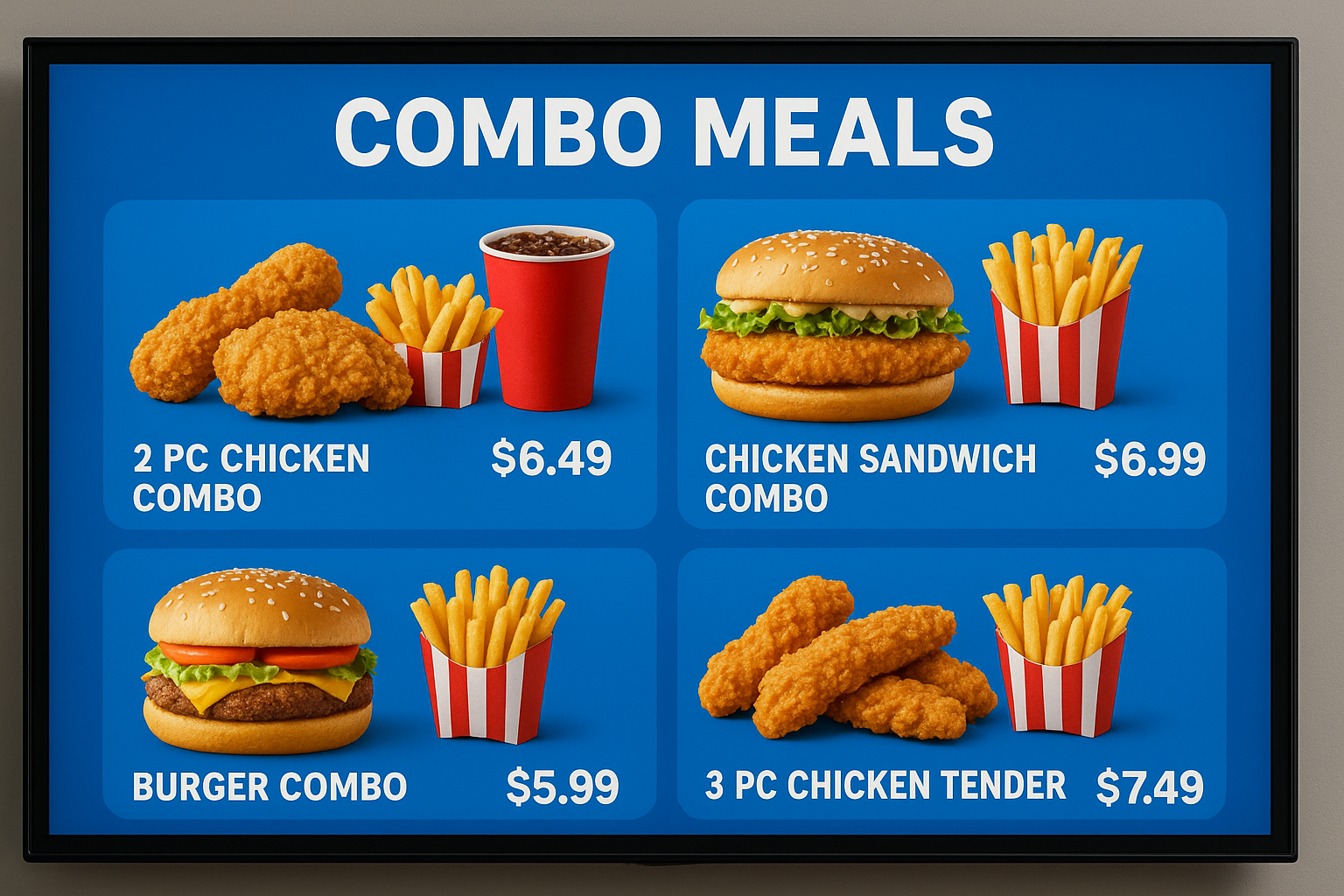
Built for faster-moving menu changes, combos, and meal-time screen switches.
QSR teams can update screen content more quickly than static board workflows
Most updates move away from store-by-store screen edits
Locations stay closer to approved menu and combo timing
Move fast on menu screens
What this lets you show on the screen
This is the fast-moving version of a menu-board workflow. It helps QSR teams update categories, combos, and daypart screens quickly across one store or many.
Breakfast, lunch, and dinner menus
Faster QSR menu and combo updates
Combo offers and add-on prompts
Daypart automation
Limited-time campaign screens
Promo blocks inside menu loops
Price, item, and availability updates
Multi-location control for QSR operations
Workflow
How teams stay in control
The point is not just publishing. It is making the screen feel managed, current, and easy to run across stores or branches.
Build menu sections
Create screen-ready categories, item groups, and combo placements.
Plan high-speed layouts
Use layouts that stay readable in quick-service environments.
Automate transitions
Switch content by meal time, campaign, or date window.
Publish across stores
Push changes to selected stores in one workflow.
Screen workflow
What the screen looks like in practice
These are the kinds of screens a team can actually publish, instead of a generic brochure-style explanation.
Faster campaign changes
QSR teams can update screen content more quickly than static board workflows
Breakfast, lunch, and dinner menus
Promo blocks inside menu loops
Combo offers and add-on prompts
Multi-location control for QSR operations
Less local rework
Most updates move away from store-by-store screen edits
Combo offers and add-on prompts
Multi-location control for QSR operations
Limited-time campaign screens
Android TV deployment support
Better rollout control
Locations stay closer to approved menu and combo timing
Limited-time campaign screens
Android TV deployment support
Price, item, and availability updates
Fallback playback during short outages
Control layer
How teams stay in control
Faster QSR menu and combo updates
QSR teams can update screen content more quickly than static board workflows
Daypart automation
Most updates move away from store-by-store screen edits
Promo blocks inside menu loops
Locations stay closer to approved menu and combo timing
Multi-location control for QSR operations
QSR teams can update screen content more quickly than static board workflows
Integrations and compatibility
Integrations
- Google Sheets or CSV menu feeds
- POS and catalog sync via API or structured data feed
- Google Reviews and social content sync
- QR-based customer ordering links
Compatibility
- Android TV appNative app for Android TV and Google TV devices
- Screen orientationLandscape and portrait layouts with safe zones
- Multi-location controlPush updates by location, region, or all screens
- Offline continuityLast published playlist stays on-screen during outages
Operations view
Manual work vs cloud control
Manual
QSR teams patch boards store by store
With GlooTV
Changes can be published centrally
Manual
Meal-time transitions rely on staff timing
With GlooTV
Schedules handle the switch automatically
Manual
Combos and promos are hard to update quickly
With GlooTV
Promo blocks can be refreshed without rebuilding everything
Manual
Locations drift from approved screens
With GlooTV
Shared control helps stores stay aligned
Day-to-day use
What teams get out of it
What teams typically see when moving from manual screen updates to centralized publishing.
Menu refresh speed
Faster campaign changes
QSR teams can update screen content more quickly than static board workflows
Operational drag
Less local rework
Most updates move away from store-by-store screen edits
Store consistency
Better rollout control
Locations stay closer to approved menu and combo timing
Common store examples
Breakfast to lunch handoff
Switch the full board at the right time without staff intervention.
Combo promotion burst
Push a new combo and upsell screen set across multiple stores quickly.
Regional pricing control
Keep one template while letting stores reflect local price differences.
FAQ
Frequently asked questions
1. How is QSR menu board software different from standard restaurant signage?
QSR setups are built around speed and volume. The priority is fast combo updates, tight daypart transitions, and running the same change across many locations simultaneously — not photography-heavy dish presentations. Standard restaurant signage leans more on ambience and storytelling; QSR leans on throughput.
2. How quickly can a combo or price change reach all screens?
From the GlooTV dashboard, a published change typically reaches all stores in the group within minutes. One publish action covers every assigned screen without contacting individual locations.
3. Can I automate breakfast-to-lunch switching at a specific time?
Yes. Daypart schedules handle the transition automatically. You set the time window once, and the board switches without staff needing to touch anything.
4. What happens to the screen if a combo is removed mid-campaign?
You update the playlist from the dashboard and republish. The change reaches screens quickly. If the connection drops temporarily, the last synced version keeps playing until it reconnects.
5. Can different stores show different prices or combos?
Yes. Store-group targeting lets you run location-specific content while keeping a shared base template. A regional combo can show only in selected stores.
6. Do I need proprietary hardware or can I use existing Android TVs?
GlooTV runs on Android TV and Google TV devices. No proprietary media player or branded hardware is required. Existing Android TV screens can be enrolled directly.
7. Can I add a limited-time offer block without rebuilding the whole menu board?
Yes. Promo slots work as a layer inside the existing playlist. You update the offer block, republish, and the core menu layout stays intact.
8. Can GlooTV handle multi-location QSR rollouts?
Yes. Stores can be grouped by region, franchise owner, or campaign target. A single publish action sends the update to all stores in the selected group.
Related pages
The broader menu-board software page
Restaurant TV menu workflows
Android TV setup and pairing details
The broader screen-management software page
See a demo, talk to sales, or create a free account.
Share a few details and we will follow up with the right next step — whether that is a tailored demo, a quick call, or getting started with your own account.