Show Menus on TV
Show menus, specials, and pricing updates on TV screens with one dashboard. Keep breakfast, lunch, and dinner content current without printing new boards.
Create a free account to explore GlooTV. If you choose premium, the monthly plan covers up to 3 TVs: ₹2,099 in India or $29 in the US. Payment starts only after you authorize checkout.
QSR teams running frequent item, price, and combo updates
Restaurant groups that need one menu workflow across locations
Operators replacing printed boards with easier daily control
See a demo, talk to sales, or create a free account.
Share a few details and we will follow up with the right next step — whether that is a tailored demo, a quick call, or getting started with your own account.
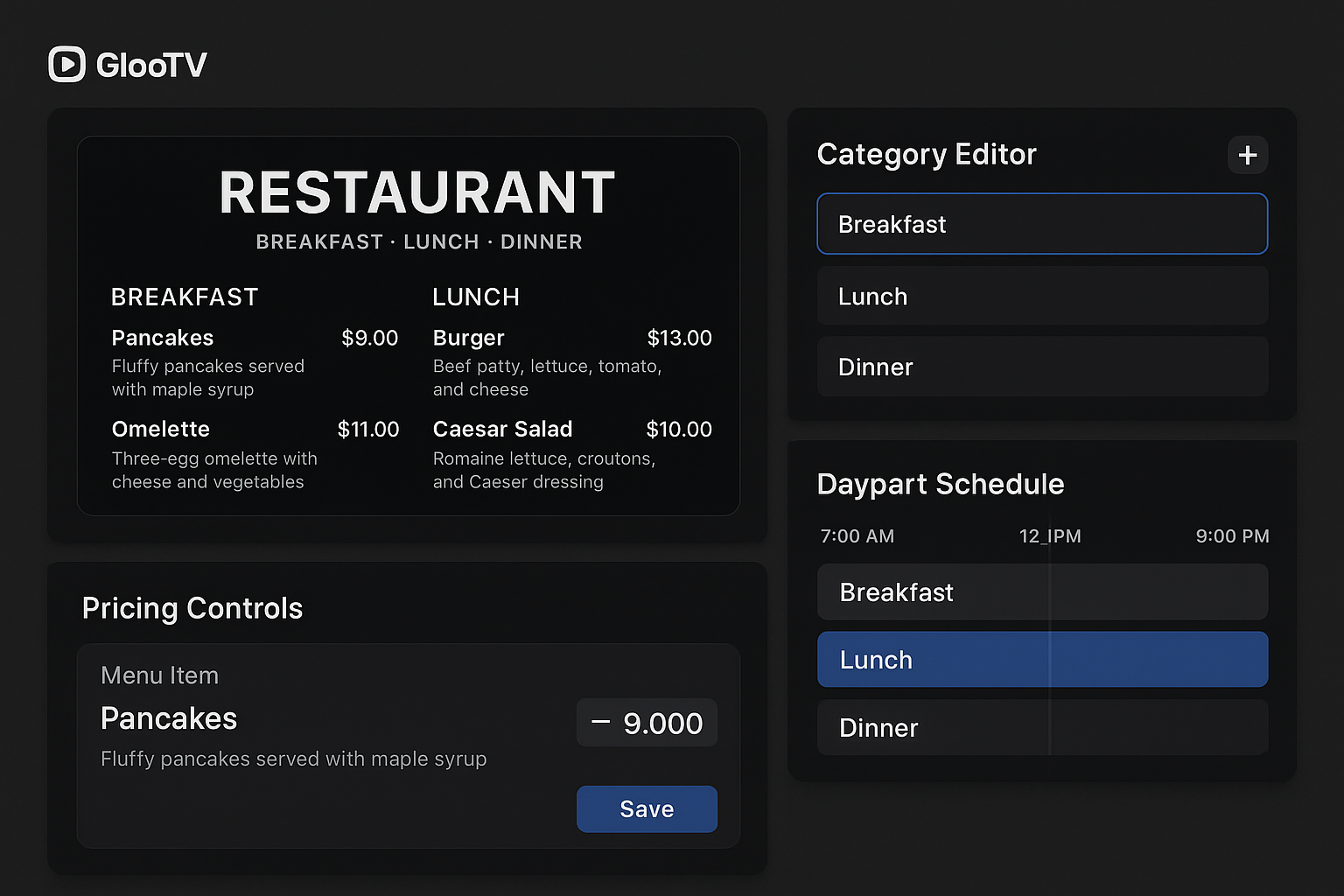
Keep menus, prices, and specials current across restaurant TV screens.
Menu changes can go live much faster than static boards
Locations stay closer to approved pricing and specials
Teams spend less time fixing old menu content
Update menus without reprints
What this lets you show on the screen
This helps restaurants move menus onto TV screens so prices, specials, and timed offers can be updated from one place.
Breakfast, lunch, and dinner menu boards
Fast price and item changes
Combo offers and limited-time specials
Daypart automation for meal-time switching
Sold-out item or price updates
Mix menu content with promo blocks
Promo banners mixed into menu loops
Multi-location governance with local overrides
Workflow
How teams stay in control
The point is not just publishing. It is making the screen feel managed, current, and easy to run across stores or branches.
Bring in menu content
Prepare menu categories, prices, highlights, and special items for screen use.
Choose readable layouts
Use TV-friendly layouts that stay easy to scan from counter distance.
Set meal-time switches
Automate breakfast, lunch, dinner, and special campaign timing.
Publish across locations
Push menu updates to one location or the full restaurant group.
Screen workflow
What the screen looks like in practice
These are the kinds of screens a team can actually publish, instead of a generic brochure-style explanation.
Minutes instead of reprints
Menu changes can go live much faster than static boards
Breakfast, lunch, and dinner menu boards
Mix menu content with promo blocks
Combo offers and limited-time specials
Multi-location governance with local overrides
Better menu alignment
Locations stay closer to approved pricing and specials
Combo offers and limited-time specials
Multi-location governance with local overrides
Sold-out item or price updates
Android TV deployment support
Less manual correction
Teams spend less time fixing old menu content
Sold-out item or price updates
Android TV deployment support
Promo banners mixed into menu loops
Offline-safe playback between syncs
Control layer
How teams stay in control
Fast price and item changes
Menu changes can go live much faster than static boards
Daypart automation for meal-time switching
Locations stay closer to approved pricing and specials
Mix menu content with promo blocks
Teams spend less time fixing old menu content
Multi-location governance with local overrides
Menu changes can go live much faster than static boards
Integrations and compatibility
Integrations
- Google Sheets or CSV menu feeds
- POS and catalog sync via API or structured data feed
- Google Reviews and social content sync
- QR-based customer ordering links
Compatibility
- Android TV appNative app for Android TV and Google TV devices
- Screen orientationLandscape and portrait layouts with safe zones
- Multi-location controlPush updates by location, region, or all screens
- Offline continuityLast published playlist stays on-screen during outages
Operations view
Manual work vs cloud control
Manual
Teams replace or edit boards manually
With GlooTV
Menu updates publish remotely to selected screens
Manual
Daypart changes depend on staff timing
With GlooTV
Schedules switch content automatically
Manual
Promos are hard to slot into existing boards
With GlooTV
Offers can be inserted into menu loops quickly
Manual
Location pricing drifts over time
With GlooTV
Shared control helps keep stores aligned
Day-to-day use
What teams get out of it
What teams typically see when moving from manual screen updates to centralized publishing.
Price-change speed
Minutes instead of reprints
Menu changes can go live much faster than static boards
Store consistency
Better menu alignment
Locations stay closer to approved pricing and specials
Operational friction
Less manual correction
Teams spend less time fixing old menu content
Common store examples
Breakfast to lunch switch
Change the entire menu board automatically at the right time.
Store-level price override
Keep a shared template while allowing local pricing when needed.
Combo upsell loop
Blend combo offers and special banners into core menu screens.
FAQ
Frequently asked questions
1. Can I show menus on TV screens?
Yes. GlooTV lets you run menus, prices, and specials on TV screens and update them from one dashboard.
2. Can I switch breakfast and lunch boards automatically?
Yes. Daypart scheduling can switch menu content by time of day.
3. Can this run on Android TV?
Yes. Android TV screens can be paired and managed remotely.
4. Can I add promotions to menu boards?
Yes. Promotions and menu content can be sequenced in the same screen loop.
5. Is this useful for multi-location restaurants?
Yes. Shared templates and location overrides support both single stores and multi-store groups.
6. What happens if internet is unstable?
Previously synced content keeps playing until the next successful update.
Related pages
The broader signage software page for store screens
Fast-food and quick-service workflows
Restaurant-specific TV menu workflows
Android TV deployment and pairing details
See a demo, talk to sales, or create a free account.
Share a few details and we will follow up with the right next step — whether that is a tailored demo, a quick call, or getting started with your own account.